

My father taught me the word Lepidoptera when I was ten years old. Scale wing. It was the first thing he gave me.
I kept moths in birdcages as a child. Fancy, brass-hinged things. I loved their powdery wings. How fragile they were. The powder isn’t powder at all. It’s thousands of tiny scales, modified hairs, layered like shingles. They refract light into color. They regulate body heat. They help with flight. Some moths carry no pigment at all. Their color is an optical trick, sunlight bending through microscopic layers on the wing. The color only exists because of movement. A moth sitting still on a leaf looks like one thing. The moment it opens its wings, light passes through those layers and everything changes. It becomes something else entirely. The same moth, the same wing, but the color shifts depending on the angle, the hour, the quality of the light. I have always loved that. That something can look ordinary until it decides to reveal itself.
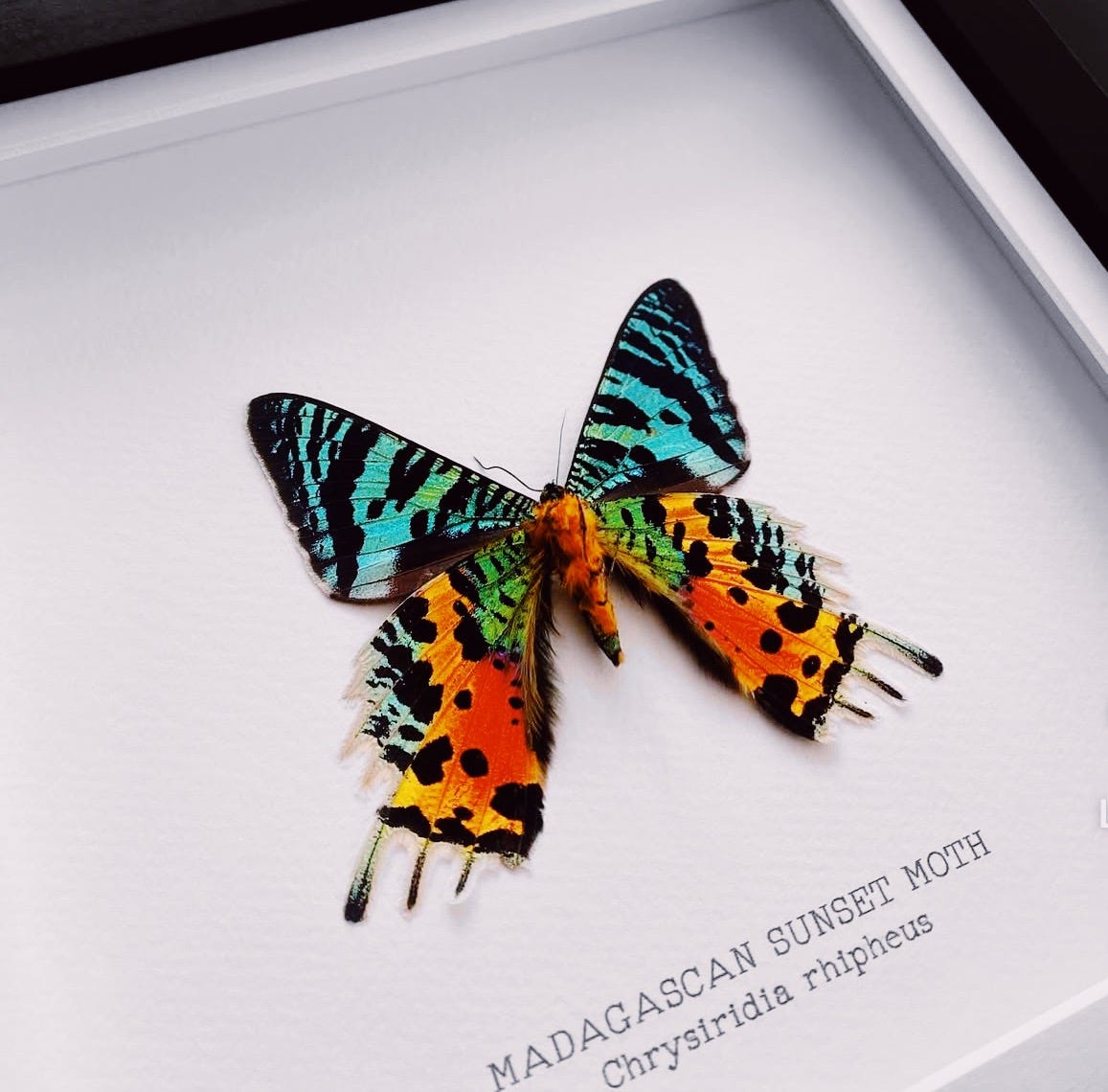
In Madagascar, they call the sunset moth adriandolo. Noble spirit. The word lolo means moth and soul at the same time, because the Malagasy people looked at the pupa, that silk-wrapped stillness, and saw a shrouded body. When the adult emerges, wings wet and trembling, they believe it is the soul of the dead returning. To harm a moth is to harm your ancestors.
My mind has always worked in categories. In order. I learned early that the world made more sense when I could name every part of it, pin it down, file it away. Moths were perfect for this. There are over 160,000 known species. I memorized wingspans and Latin names and migration patterns. I could tell you that the sunset moth was first described in 1773 by an entomologist named Dru Drury, who was so fooled by its iridescent wings that he classified it as a butterfly. It took fifty years for someone to correct him. His original specimen had even arrived with the wrong head attached, likely a butterfly’s, its clubbed antennae convincing everyone of something that was never true. The moth spent half a century being called the wrong thing, and nobody questioned it, because it was easier to believe what they saw on the surface than to look closer. I have spent most of my life understanding that feeling. There are things about the way I move through the world that people don’t look closely enough to see. And when you correct them, when you say actually, this is what I am, they don’t always want to hear it. So you stop correcting. You let them call you the wrong thing. You keep your wings shut.
People tattoo butterflies on their skin. They print them on greeting cards and hang them in nurseries and call them symbols of hope. But no one makes a sympathy card with a moth on it. No one gets a moth tattooed after a miscarriage. It is one of the great misunderstandings of the natural world. The Spanish moon moth, Graellsia isabellae, has pale green wings with long, spiraling tails that look like they were drawn by someone who had too much beauty to contain. The rosy maple moth, Dryocampa rubicunda, is so pink and yellow it looks fake, like a piece of candy someone left in the grass. The Madagascar bull’s eye moth, Antherina suraka, wears false eyes on its wings so convincing that predators flinch. The hybrid luna moth glows the color of seafoam in moonlight. The comet moth, Argema mittrei, trails tails up to twenty centimeters long, the longest of any moth alive. The Picasso moth, Baorisa hieroglyphica, carries patterns on its wings that look like someone painted them with a deliberate hand. The Chinese moon moth, Actias dubernardi, has wings so pale and fine they’re almost translucent. All of this, and still the world picks the butterfly. Still the world looks at the obvious thing and calls it beautiful, and walks right past the rest.
Not everyone handles fragile things gently. I won’t name them. I don’t need to. They know who they are, and more importantly, I know who they are, and that is enough. The world is full of people who will grab you too hard and then act confused when your color comes off. Who will hold you up to the light and say you were never that bright to begin with. A moth can lose every scale on its wings and still take flight. It will be cold. It will be visible. It will be alone. But it still flies. You can strip every scale from a moth’s body and it will still fly. Remember that.
The sunset moth feeds exclusively on Omphalea, a genus of plants that are toxic. Here is what happens. The caterpillar eats the poison. It does not die. It absorbs the toxin into its body and keeps it through every stage of transformation, through the pupa, through the emergence, into adulthood. The bright colors on its wings are not decoration. They are a warning. In biology this is called aposematism. It means I am beautiful, and if you put your mouth on me, I will make you sick. Thousands of sunset moths migrate across Madagascar together, flying over the crowns of trees, and when the wind knocks them down they fall to the ground with their wings shut. And then they get up. They always get up. Be careful with things that have survived their own transformation. They are not as fragile as you think.
In 1889, Vincent van Gogh found a rare death’s-head hawkmoth and wrote to his brother Theo about it. He described its coloring as astonishingly distinguished. Black, grey, white, shaded, with glints of carmine. He wanted to paint it. But to paint it he would have had to kill it, and he could not bring himself to do it. One of the greatest artists who ever lived looked at a moth and decided it was too important to destroy. He sketched it alive instead. There are people in this world who see something beautiful and want to preserve it. And there are people who see something beautiful and want to hold it captive, control it, take it apart so no one else can have it. You learn very quickly which kind of person you are dealing with.
In Hawaii, when someone dies, and a black witch moth appears, they believe it is the soul of the dead returning to say goodbye. The moth’s Latin name is Ascalapha odorata. Its other names are the mourning moth. The sorrow moth. I don’t know if my father came back to say goodbye. I don’t know if he got that. He was the one thing in my life that never failed, and then his heart stopped, and I have been waiting three years for something with wings to come through the door and tell me he is okay. Some days it feels like the last thing he gave me was that word. Grief is not what they tell you it is. It is not stages. It is not a hallway with a room at the end. It is a moth’s wing. It is that fragile. And it does not go away. It just changes color in the light
.